
Flat and low-slope roofs on warehouses, manufacturing facilities, and multi-tenant buildings in Fort Wayne, IN, take a sustained beating through every season. Winter freeze-thaw cycles, heavy snow loads, ponding water, and summer heat expansion work against every seam, flashing, and membrane edge on the roof surface. When a leak finally appears inside the building, it is rarely the beginning of the problem. By the time water shows up on a ceiling tile or along a wall, the roofing system has typically been failing quietly for weeks or months.
Tri-County Commercial Roofing LLC has worked exclusively with commercial properties across northern Indiana since 2014, and the pattern is consistent across the region: buildings that receive repeated surface patches without a proper assessment end up with damage well beyond what was visible at the surface. Saturated insulation, compromised decking, and failed membrane seams do not repair themselves between seasons. A certified commercial roofing contractor can identify what is actually failing, determine whether roof repair will hold long-term, and tell a property owner honestly when commercial roof replacement is the right path forward. That distinction matters more than most building owners realize until the damage has already spread.
What a Temporary Roof Patch Actually Does
A temporary roof patch is a surface-level application. It typically involves a sealant, coating, or patch membrane applied over a visible area of damage to stop active water intrusion. It is not designed to restore the structural integrity of the roofing system below. A patch stops visible leaking. It does not address moisture that has already infiltrated the insulation, seams, or structural deck beneath.
Once water enters a roofing system, it follows the path of least resistance. That path often runs well beyond the location where a visible leak appears inside the building. A ceiling stain in one corner of a warehouse does not always mean the roof failure is directly above it. Water travels laterally through saturated insulation before finding a way into the building interior.
Patching above the visible stain leaves the actual failure point unaddressed. Water continues to travel. Insulation continues to absorb moisture. The next leak appears in a different location a season or two later, and the cycle repeats.
Three Types of Hidden Damage That Surface Repairs Miss
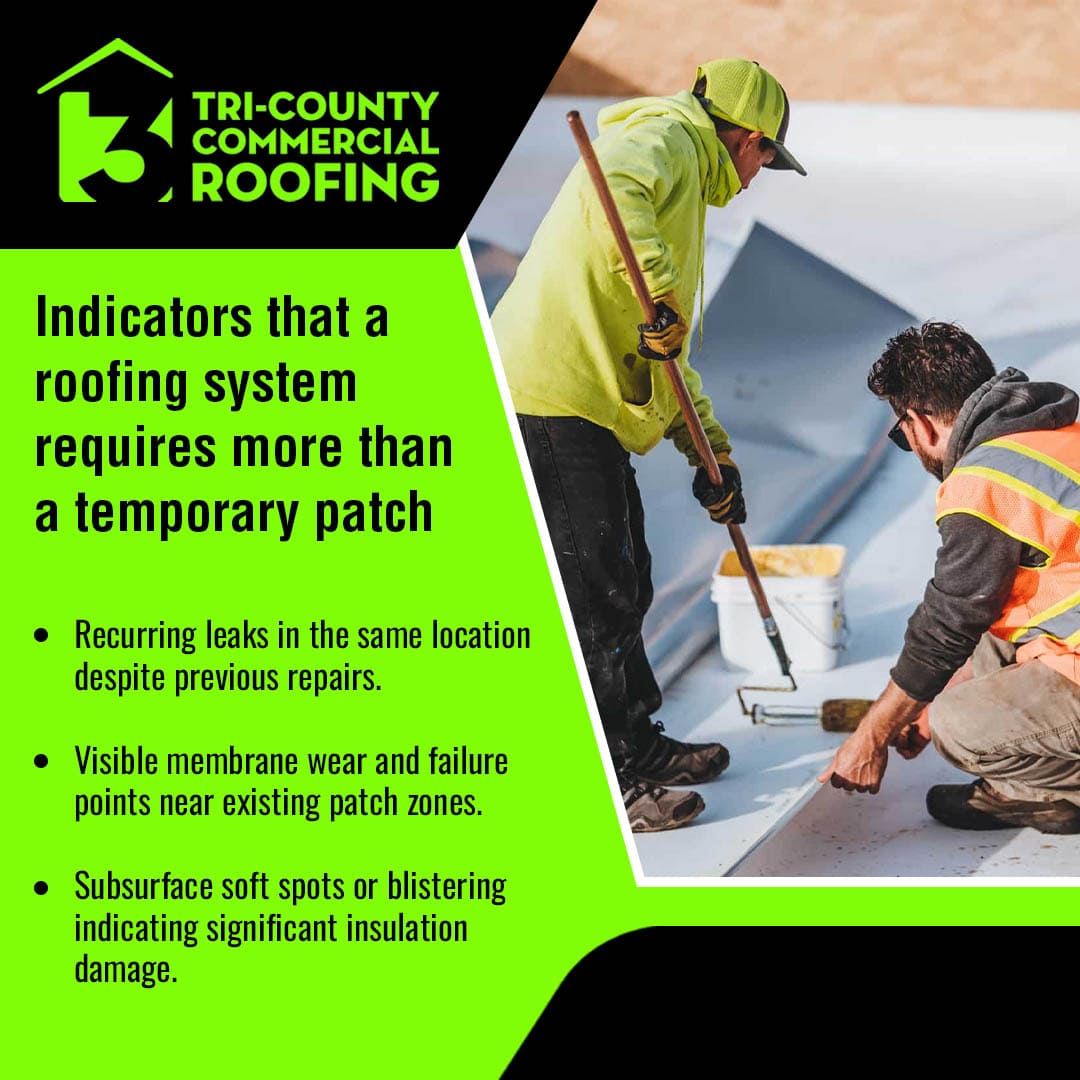
Temporary surface repairs consistently miss three types of subsurface damage: insulation saturation, membrane deterioration, and structural deck damage. Each worsens independently and compounds the others over time.
Insulation Saturation
Flat and low-slope roofing systems use rigid insulation boards beneath the membrane to control thermal performance and support the roof structure. When water bypasses the membrane, those boards absorb moisture and lose their thermal resistance.
Saturated insulation does not dry out passively. It retains moisture through multiple seasons, adds dead weight to the roof structure, and creates persistent moisture pressure against both the membrane above and the structural deck below.
A warehouse owner whose insulation becomes saturated across a large section may notice interior temperature regulation issues before a new roof leak ever appears. The insulation is deteriorating while the patch on the membrane surface looks intact.
Membrane Deterioration Around the Repair Zone
The membrane is the waterproof layer on the roof surface. It degrades with age and repeated weather exposure. When a patch is applied to an aging membrane, the patch material bonds to a substrate that is already weakening at the surrounding seams and edges.
The patch may hold for one or two seasons. The membrane around it continues to age, lose flexibility, and develop new failure points near the original repair zone. This is particularly true in northern Indiana, where the freeze-thaw cycle places repeated stress on membrane seams throughout the winter months.
A manufacturing facility with a 22-year-old TPO (Thermoplastic Polyolefin, a single-ply reflective roofing membrane) that receives a patch over a seam failure is not extending the life of that system. The surrounding membrane is already near the end of its service range. New failures typically develop in adjacent sections within one to three seasons.
Structural Deck Damage
Once moisture reaches the structural deck beneath the insulation, the scope of necessary work expands beyond what any surface repair can address. Wood decking rots. Metal decking corrodes. Either condition must be remediated before a new roofing system can be installed above it.
A church administrator who has patched the same section of a low-slope roof three times over four years is not avoiding a larger project. They are building toward a re-roofing scope that now includes deck remediation, full insulation replacement, and a new membrane, rather than the targeted repair that was possible after the first failure.
How the Freeze-Thaw Cycle Accelerates Subsurface Damage
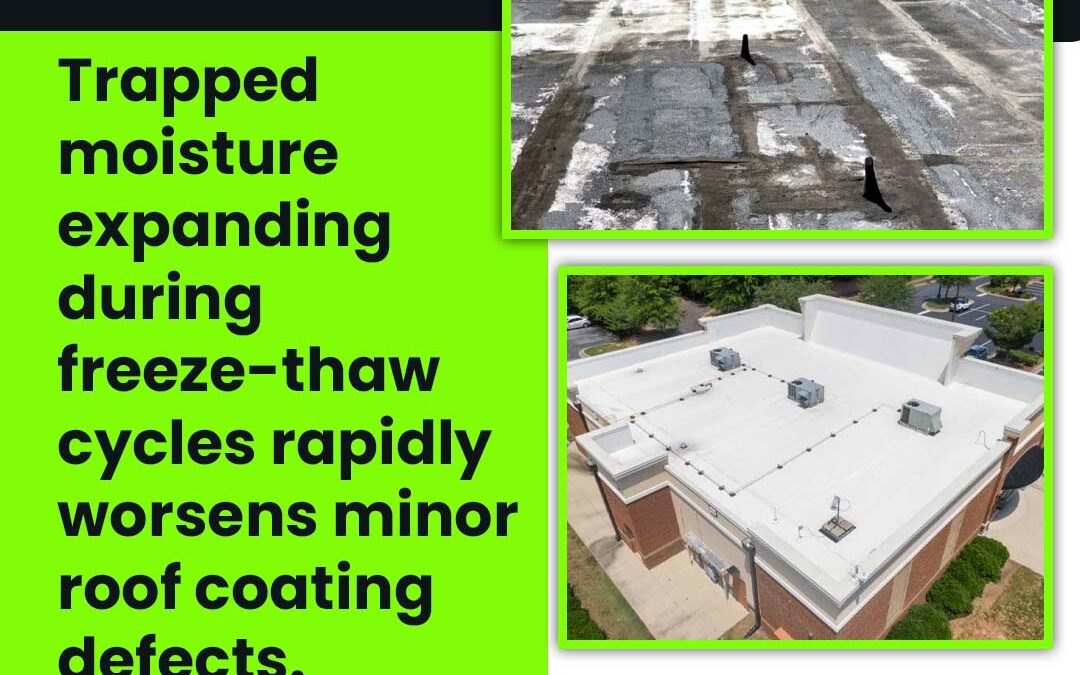
The freeze-thaw cycle forces water into every small opening in a roofing system, expands it as temperatures drop below 32 degrees Fahrenheit, and widens the gap with each subsequent thaw.
Northern Indiana winters subject flat and low-slope roofing systems to this process dozens of times per season. A patch applied in October that appears intact may allow a new and larger failure by March. The patch edge, the surrounding membrane, and any unsealed penetrations nearby have all been subjected to repeated freeze-thaw stress between application and the spring thaw.
Common Failure Points Under Freeze-Thaw Stress
- Seam edges are not fully re-bonded during patch application. Water enters the gap, freezes, and widens the unsealed portion with each cycle.
- Drain areas with partial blockage. Standing water around a partially blocked drain freezes and concentrates pressure at one of the roof’s most vulnerable transition points.
- Flashing gaps at rooftop penetrations. HVAC units, vents, and pipes that pass through the roof require sealed transitions. A deteriorating sealant bead at any penetration point allows water to enter, freeze, and widen the gap through winter.
A multi-tenant retail property manager who patches around a rooftop HVAC unit without addressing the flashing at that penetration will see the gap widen through the winter. By spring, what was a localized sealant issue has become a flashing failure requiring more extensive work.
Pattern of Repeated Temporary Repairs
Repeated temporary repairs on a commercial roofing system follow a predictable pattern that results in a larger scope of work than a single qualified repair would have required.
How the Repair Cycle Typically Develops
The following scenario illustrates how deferred repairs typically develop on a commercial roofing system:
- Year 1: An isolated leak appears. A patch is applied. The underlying cause, whether a seam failure, flashing gap, or deteriorating membrane, is not fully assessed.
- Year 2: A second leak appears nearby. Another patch is applied. By this point, insulation in the affected section has begun to saturate. No moisture testing is performed.
- Year 3: A third leak develops in a different area of the same roof, indicating broader membrane failure.
- Years 4 to 5: Water reaches the structural deck. The necessary scope now includes deck remediation, full insulation replacement, and a new membrane. Commercial roof replacement across a larger portion of the building becomes the only practical path forward.
Regular inspections and proper maintenance are the most critical factors in achieving long-term roof system performance. Buildings whose roofs are examined only after a leak occurs consistently face a larger scope of damage than those maintained on a scheduled basis.
What a Qualified Commercial Roof Repair Involves
A qualified commercial roof repair identifies and addresses the source of failure, not just the location where water became visible inside the building. This distinction is the difference between a repair that resolves the problem and one that delays the next failure by a season.
Steps a Certified Commercial Roofing Contractor Follows
A certified commercial roofing contractor approaches every commercial roof repair with a defined process before any material is applied. Working with a qualified contractor rather than a general crew makes a direct difference in whether the repair holds through the next season:
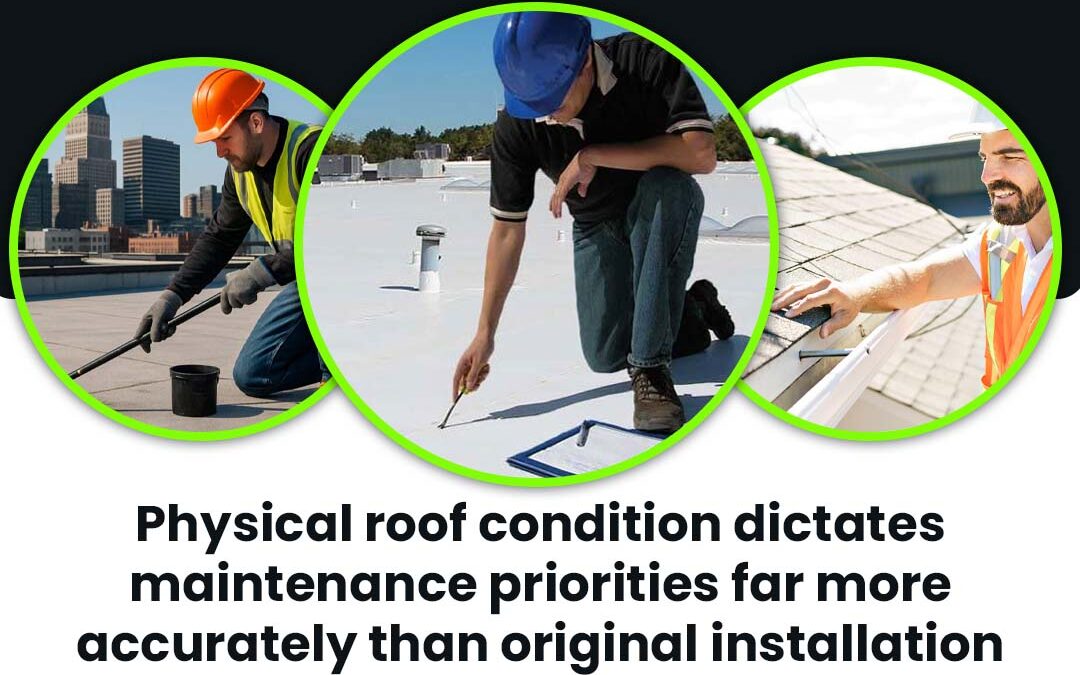
- Full commercial roof surface inspection, not limited to the area above the interior leak point.
- Moisture testing of insulation in surrounding sections to identify saturation before it causes structural damage.
- Seam and flashing evaluation at all penetrations and transitions near the affected area.
- Roof surface condition assessment to determine whether the system has an isolated failure or broader deterioration across the roofing assembly.
After the assessment, the scope of repair reflects what was actually found on that commercial roofing system. If the roof surface condition in the surrounding area is sound, an isolated repair is appropriate. If moisture testing reveals saturation in a wider area, the scope expands accordingly, and the property owner receives that information before any work begins.
When Temporary Repairs Delay the Replacement Decision Too Long
The danger of repeated surface patches is not just the damage they leave unaddressed. It is that they reset a property owner’s urgency, making a roof that needs replacement feel manageable for another season.
A patch stops the visible leak. The interior stain dries. The building feels stable. That window of calm is real, but the roofing system beneath it continues to deteriorate. By the time the next failure appears, the system has moved further past the point where targeted commercial roof repair was a sound long-term investment.
The following conditions indicate that the replacement decision has already been delayed too long:
- Repairs are being made to the same roof section more than once within two years. The underlying system is no longer holding the fix.
- Core sampling, which involves removing circular sections of the roofing layers to inspect insulation and decking below the surface, reveals saturation across multiple sections. The damage is no longer isolated, and no surface repair changes what is happening below.
- The roof is past 20 years old with a documented history of patches. Each additional repair is extending a system that has already exceeded its practical service life.
A property owner who recognizes these conditions early can plan a commercial roof replacement on their own schedule. One who continues patching loses that option and responds to failure instead.
Warning Signs That Require Professional Assessment Now
The following conditions indicate that professional inspection, not another surface patch, is the appropriate next step.
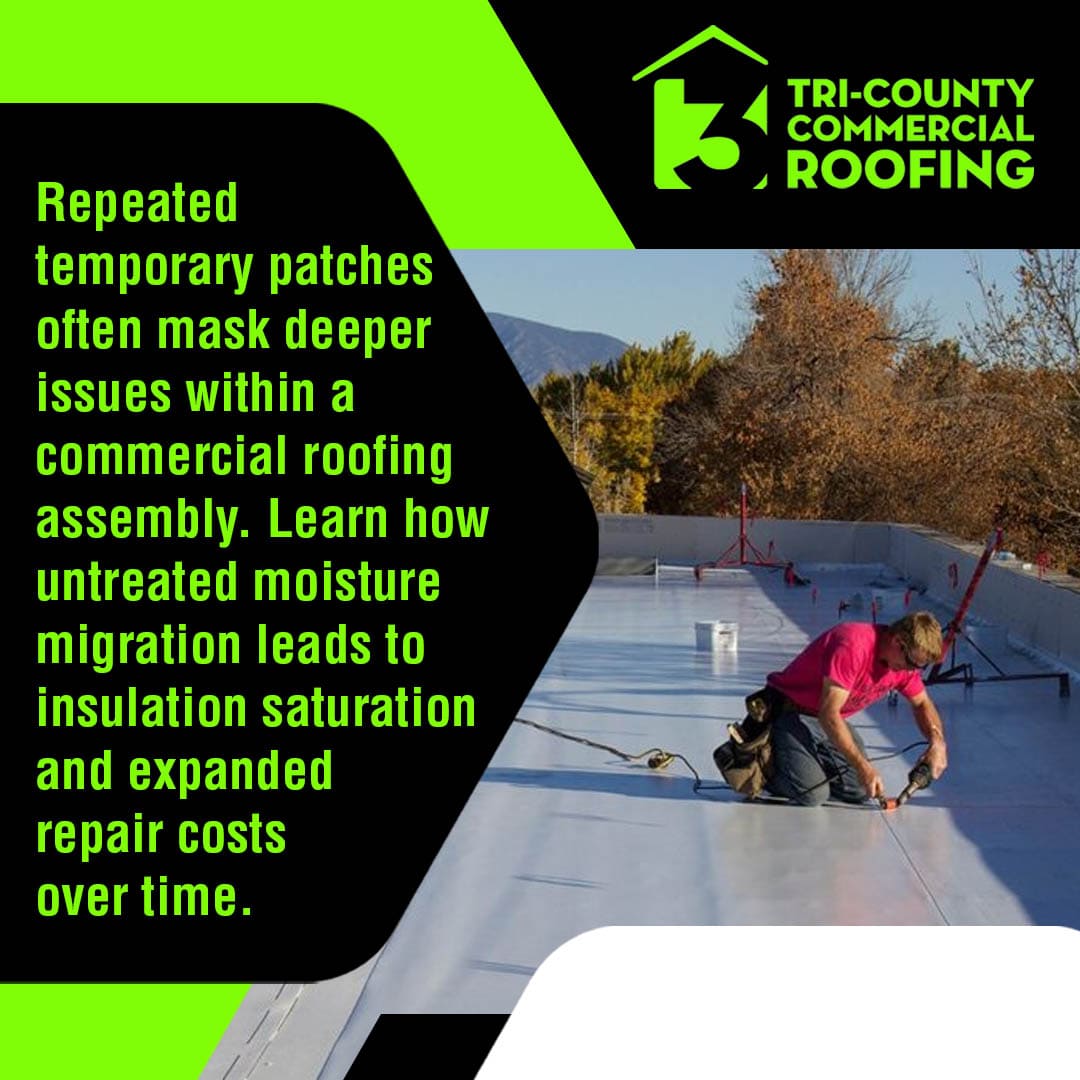
Indicators of Subsurface or Systemic Failure
- Interior water stains that reappear after a previous repair. The source of failure was not fully resolved.
- Soft spots on the roof surface underfoot. Saturated insulation beneath has lost structural support.
- Membrane bubbling or blistering. Sub-surface moisture is pushing upward from below.
- Lifted or separated seams. Seam failure is the most common water entry point on flat and low-slope commercial roofing systems.
Multiple conditions appearing together typically point toward full roof replacement rather than continued repair work on the existing system.
Professional Roof Assessment for Fort Wayne Commercial Properties
Tri-County Commercial Roofing has worked exclusively with commercial properties across northern Indiana since 2014. As a certified commercial roofing contractor, every inspection we conduct includes a full surface evaluation, drainage review, seam and flashing assessment, and a written report of findings.
What to Expect From Every Inspection
When targeted repair is the right answer, Tri-County Commercial Roofing executes it to manufacturer specifications, protecting warranty coverage and addressing the actual source of failure. When a system has deteriorated beyond practical repair, we provide a direct written replacement assessment with a clear explanation of what we found, so property owners can plan on their schedule rather than respond to the next failure.
Merle Bontrager, founder and factory-trained certified installer, leads every Tri-County Commercial Roofing project with installation standards that meet manufacturer requirements and protect the long-term performance of every roofing system we put in place.
Why Fort Wayne Property Owners Trust Tri-County Commercial Roofing
Unlike general contractors who handle commercial work alongside residential projects, we focus exclusively on commercial properties. That singular focus means every assessment we conduct, every repair recommendation we make, and every installation decision we execute is grounded in commercial roofing experience specific to the demands of northern Indiana’s climate.
Schedule Your Fort Wayne Commercial Roof Repair Assessment Today
Contact Tri-County Commercial Roofing at (260) 248-7020 to schedule a professional roof assessment. We serve Fort Wayne and commercial properties throughout northern Indiana and the surrounding Midwest.